
The Russian Orloff Society of USA & Canada
The Russian Orloff and the American Poultry Association;
An age old myth and why its time to put it to rest
Myth
The Russian Orloff was at one time an accepted breed in the American Poultry Association’s Standard of Perfection
Fact
The Russian Orloff has never been an accepted breed within the American Poultry Association. It did not “fall out of favor,” nor was it “removed due to inactivity.”
The American Poultry Association (APA) was established in 1873 and incorporated in 1932. The APA serves as the governing body responsible for maintaining records and the Standard of Perfection for recognized poultry breeds. Not all breeds achieve this distinction; the existence of a breed does not automatically qualify one for being listed.
For a breed to be “in the Standard,” years of work must first be completed to demonstrate that it breeds true to its defined characteristics. The APA exists to standardize, preserve, and promote purebred poultry in America. Without this process, breeds would not remain consistent or recognizable.
And that brings us back to the Russian Orloff.
While there is no definitive documentation pinpointing exactly when or how the Russian Orloff arrived in North America, historical references do exist. An article in Poultry Tribune (Volume 27, Page 65, 1921) notes Russian Orloffs present in several poultry yards and winning blue ribbons in Chicago and New York. Additionally, a 1919 issue of The Poultry Item includes an advertisement offering Mahogany Orloffs from Georgia, describing them as a relatively new arrival to the United States.
Mahogany Russian Orloffs, 1919
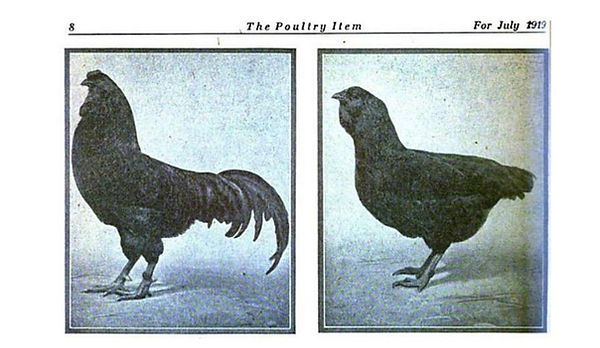
The myth we continue to encounter is the claim that the Russian Orloff was once included in the APA Standard and later removed. However, research conducted by historians within the Russian Orloff Society has demonstrated that this was never the case.
The confusion appears to stem from a different bird entirely—one referred to simply as the “Russian,” not the “Russian Orloff.”
When examining an early APA Standard of Excellence dated January 15, 1875 (printed in 1876), the “Russian” is described as an all-black bird with dark legs (yellow being a disqualification), a double or rose comb, long pendant wattles, a dark beak, and black muffs and beard.
By description alone, this bird does not match the Russian Orloff.


Further supporting this distinction, Poultry World (Volume I, No. 11, November 1872) features the “Black Russian Fowl” as its breed of the month. Over time, the name was shortened to simply “Russians,” contributing further to the confusion.
Russian Orloffs are documented as having reached Germany and the United Kingdom around 1911, which would likely place their arrival in American hands sometime after that date. When comparing the historical descriptions and illustrations of the Black Russian Fowl with the known characteristics of the Russian Orloff, it becomes clear that these are entirely different breeds.


